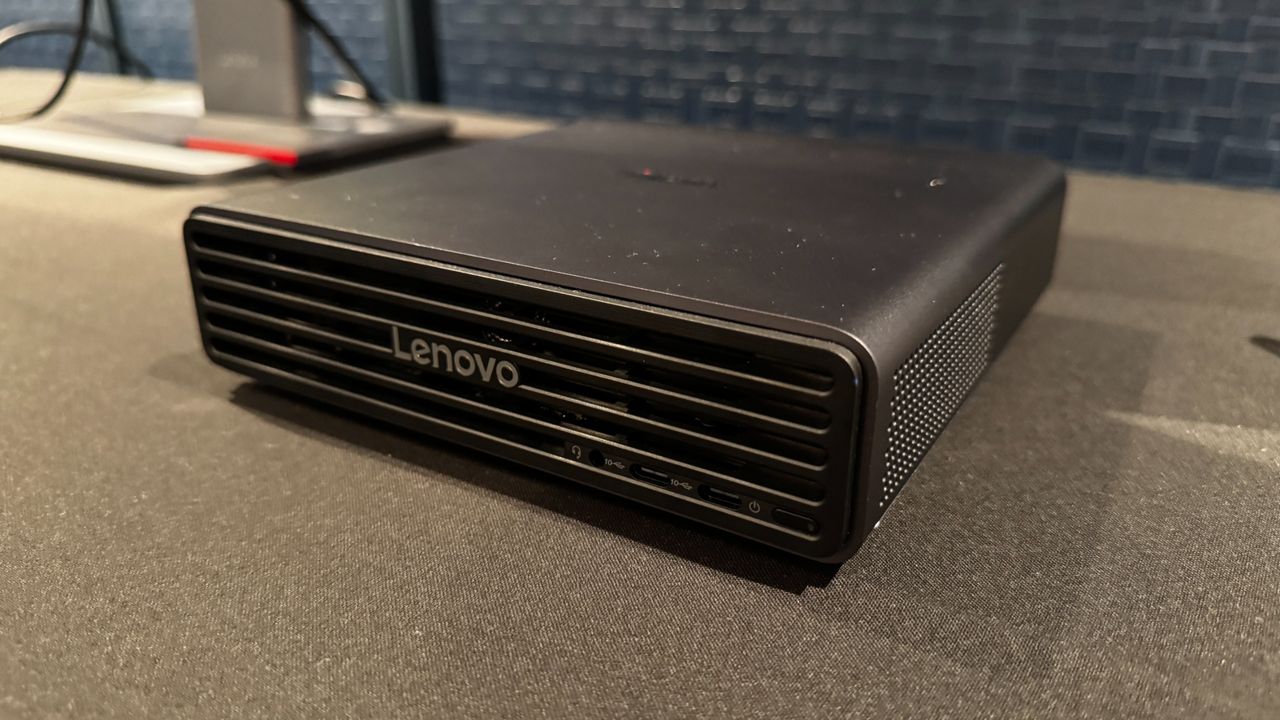
AMD and Lenovo unveiled two distinct computing systems at IFA 2026 designed to shift intensive AI processing from cloud infrastructure to local hardware. The partnership introduces the compact ThinkCentre X Ultra desktop and the high-performance Threadripper Halo Station workstation, both engineered to handle large-scale machine learning tasks on-site.
ThinkCentre X Ultra specifications
The ThinkCentre X Ultra utilizes the AMD Ryzen AI Max+ Pro 495 processor paired with a Radeon 8065S GPU. The system supports up to 128GB of RAM, providing sufficient overhead for localized model inference. Lenovo designed the chassis to support clustering, allowing users to link up to four units to execute multi-agent workflows. The product is scheduled for a November 2026 release with a starting price of $3,669. This configuration targets professional environments requiring moderate AI compute density without the footprint of traditional server racks.
Threadripper Halo Station performance
AMD’s Threadripper Halo Station addresses enterprise-level requirements by leveraging the 96-core, 192-thread Threadripper PRO 9995WX CPU, which achieves clock speeds up to 5.4 GHz. The workstation architecture supports up to 2TB of DDR5 memory. The most significant hardware inclusion is the capacity for four liquid-cooled AMD Instinct MI350P accelerators, providing a combined 576GB of HBM3E memory with a bandwidth of 4 TB/s. While AMD has not disclosed a final price or specific release date for the Halo Station, the hardware architecture is specifically calibrated to process trillion-parameter models directly on a workstation.
By decoupling AI development from cloud-based dependencies, these systems provide a path for organizations to manage sensitive data and complex model training entirely on local hardware. The ThinkCentre X Ultra offers a scalable entry point for developers needing modular, multi-agent capabilities, while the Threadripper Halo Station provides the raw memory bandwidth and core counts necessary for high-parameter model development that previously required data center access. This hardware shift indicates a transition toward localized heavy-compute environments for AI research and deployment, prioritizing data sovereignty and reduced latency over remote processing. The ability to manage trillion-parameter models on a single workstation represents a shift in the hardware requirements for developers who must iterate on large-scale architectures without the overhead of cloud subscription models or data transmission constraints.
Furthermore, the integration of HBM3E memory at such high bandwidths within the Halo Station architecture addresses the primary bottleneck that has historically hindered local AI development: memory latency. By providing a massive 576GB pool of high-speed memory, AMD is effectively enabling researchers to load entire large language models into VRAM, eliminating the need for constant data swapping between system RAM and storage. This capability is critical for fine-tuning operations and real-time inference, where every millisecond of latency can impact the agility of the development cycle.