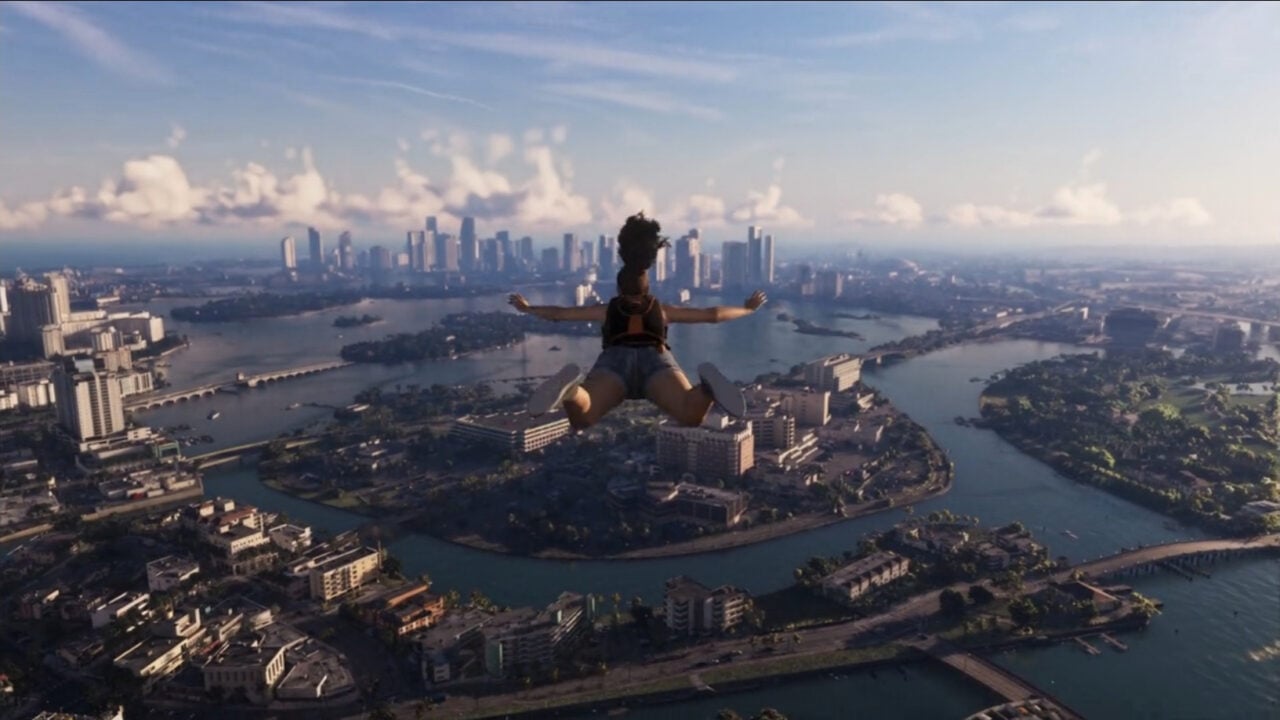
Rockstar Games unveiled a 27-minute Netflix showcase for Grand Theft Auto 6, confirming the game’s map spans three times the area of Red Dead Redemption 2 and twice that of Grand Theft Auto V. The expanded world includes a reimagined Vice City, now twice the size of GTA 5’s Los Santos, along with suburbs covering 11 times the original city’s footprint. The presentation highlighted hundreds of accessible interiors, a karma system that tracks player behavior in granular detail, and a reworked driving model featuring narrower streets and realistic vehicle scaling.
Map Scale and Exploration
The playable map measures significantly larger than previous entries, with Vice City serving as a central hub surrounded by extensive suburban and rural zones. Rockstar emphasized verticality and density, noting that many buildings contain fully interactive interiors. Fast travel options were not detailed, but the sheer scale suggests traversal will rely heavily on the game’s updated vehicle and GPS systems.
Karma System and Player Consequences
A new karma system monitors both major and minor actions, influencing NPC reactions, mission availability, and story outcomes. Positive behaviors such as helping civilians or avoiding excessive violence can unlock alternate dialogue paths and hidden rewards. Conversely, repeated criminal acts escalate the player’s criminal profile, triggering more aggressive law enforcement responses and limiting access to certain areas or services.
Driving Mechanics and Vehicle Theft
Driving has been adjusted for realism, with tighter handling, narrower roads, and increased collision sensitivity. High-end vehicles feature advanced GPS tracking, forcing players to plan escapes more carefully after theft. Car theft is tiered: lower-tier vehicles remain locked until specific story milestones are reached, while later-game carjacking remains possible but riskier due to enhanced police pursuit mechanics. The wanted system now allows players to temporarily split from pursuing officers, enabling tactical disengagement during chases.
GTA 6’s design shifts emphasize player choice, environmental detail, and mechanical depth over rapid progression. The integration of a morality framework with a drastically expanded map suggests Rockstar intends to support long-term engagement through systemic gameplay rather than scripted sequences alone.
This granular approach to player consequence extends beyond the karma meter into a fully realized criminal profile. This system, distinct from the traditional star-based wanted level, appears to track specific criminal activities, their frequency, and their severity. A player who relies on strategic, non-lethal takedowns will build a different profile than one who engages in chaotic, violent rampages. This profile is not merely cosmetic; it is expected to dynamically alter the game world. Certain missions may become available only to players with a "clean" or a specific type of "professional" record, while merchants might offer better prices to those with a low intimidation factor. The dossier's mention of being able to "split from cops" suggests this profile also influences pursuit tactics, with specialized units potentially being dispatched based on the player's established modus operandi.